sunrun
A clickable prototype of Sunrun's online solar and battery sales journey, from typing in an address to the day the system turns on. Built in code at Bridger Creative and reviewed with Sunrun's team in working sessions.
Sunrun asked for the whole sale online with no sales call: design a system for your roof, reserve it, sign, book the install, and follow it to power on. Two more groups needed their own way in: homeowners who already have solar or a battery from any company, and existing Sunrun customers. And it had to hold up in front of Sunrun's legal team, because every savings number on the page reads as a promise.
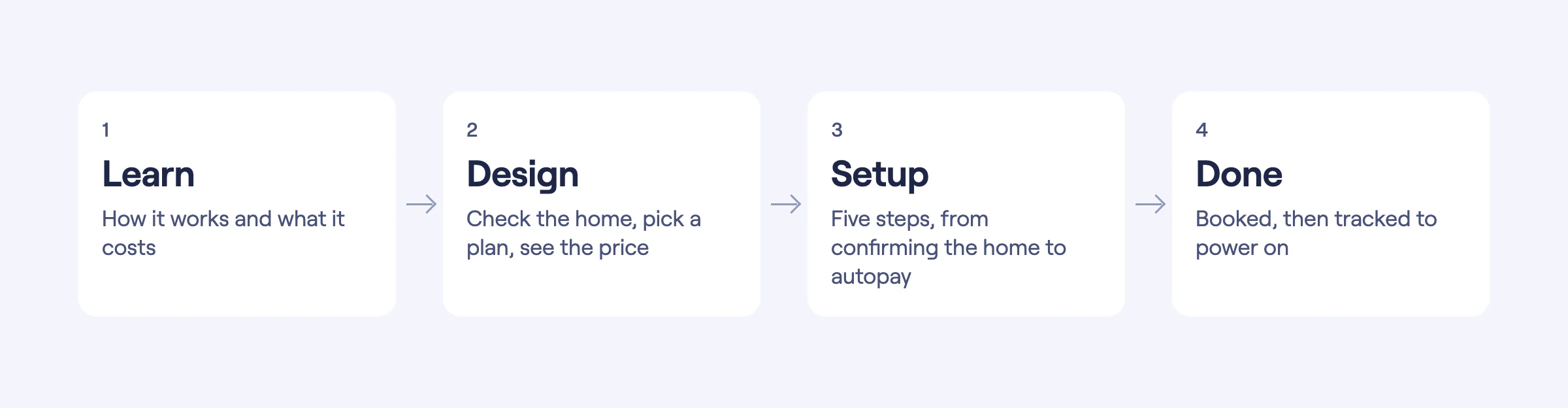
Four journeys share one system. A new customer enters an address and watches the home get evaluated stage by stage, roof, sun and trees, before it says the home qualifies. The plan picker shows the same house by day and night with power flowing for each plan, so utility only, solar, battery and both read at a glance. Setup is five steps on a rail: confirm the home, sign the agreement, a home review, the install date and autopay. When engineering changes the design after the home review, one design review shows what changed, the new price and the signature, with autopay offered in the same place. Homeowners adding to an existing system answer five quick questions, starting from pictures of their own kind of setup, and land on one page of options. Help follows Sunrun's support plan for each stage.
Two rules from Sunrun shaped the numbers. Legal asked that any utility rate assumption sit at or below the historic trend, so the bill chart starts at the 15-year California average, caps the slider at 10%, the CPUC limit, and always shows the Sunrun payment next to what is left of the utility bill. And talking to a person should never quietly cost more: asking for a sales consultant first explains that consultants quote standard pricing, with one tap to keep the online price.
Small calls kept trust intact. Log in asks for a phone number or email first, so typing an address never reveals who is already a customer. Future loads like an EV or a heat pump show as a dashed cap on top of today's cost instead of rewriting last year's bill. An audit of Sunrun's own earlier prototype turned up issues like these, and this version fixes them.
- Claude Code
- designed and built in code
- Next.js
- and React, with view transitions
- Vercel
- three builds, one per audience
Every flow with more than two states, or a mocked wait, runs on an explicit state machine, so the prototype behaves the same in every review and changes stay safe at speed. Demo controls let the team jump to any setup step or any engineering outcome in a meeting. The three builds are new customers, add-on owners and existing customers.
Still in review with Sunrun. Prices and timelines in the prototype are placeholders until Sunrun supplies real values. The journey, the copy rules and the legal guardrails are the work.